
Physicists Sound the Alarm on the ‘Golden Dome’ Boondoggle
A Call Not to Fund the “Golden Dome”
Golden Dome, the Trump Administration’s concept for a defense against Intercontinental Ballistic Missile attacks on the US, calls for deploying missile interceptors in space. Such a system would be ineffective, enormously expensive, and dangerously provocative to Russia and China.
Golden Dome’s requirement for space-based interceptors to attack ballistic missiles very early in flight acknowledges the vulnerability to decoys and other countermeasures of the current strategic defense system, the Ground-based Midcourse Defense (GMD). The US has spent $400 billion over decades on ballistic missile defense, without producing an effective defense. Expanding GMD and similar systems will cost many billions of additional dollars without increasing US security.
Golden Dome envisions avoiding the problems with GMD by deploying a space-based “boost-phase” defense, which would put interceptors into orbits around the Earth from which they could, in concept, intercept nuclear-armed ballistic missiles before they release decoys and multiple warheads at the end of powered flight.
Since the satellites carrying space-based interceptors must travel at high-speed in low-altitude orbits to counter gravity, any satellite could only attempt to intercept a boosting ICBM during the short time interval (perhaps 60 seconds) when the interceptor passed near the location of the boosting missile. Thousands of interceptors are therefore needed to have at least one in the right position at any time.
According to a study of missile defense by the American Physical Society, more than 1,000 orbiting interceptors are needed to assure that at least one is always in position to intercept the launch of a single modern ICBM, depending on how much decision-time the defense allows itself. Defending against multiple missiles would require deploying multiple layers of this size. Attempting to defend against a large attack consisting of hundreds of missiles would require many times this number of interceptors.
Golden Dome would be Ineffective
Even with thousands of interceptors in space, by launching multiple missiles simultaneously an adversary could locally overwhelm such a defense. Countering a salvo of 10 ICBMs launched at the same time from the same area would require the defense to deploy 16,000 to 36,000 interceptors. Russia and China currently deploy hundreds of ICBMs.
Moreover, there are known countermeasures to boost-phase intercepts. For example, building ICBMs with very short burn times can leave too short a time for interceptors to accelerate out of their orbits and reach the missiles while their engines are burning. Interceptors in low-altitude orbits are themselves vulnerable to attack. An adversary could destroy interceptors using a small number of inexpensive, short-range missiles carrying anti-satellite weapons, launched from the ground, airplanes, high-flying drones or ships, punching a hole in the satellite constellation that ICBM’s could be launched through unopposed.
If space-based defenses were instead used to attempt to intercept during midcourse rather than boost phase, they would face the same decoy problem as existing midcourse defenses.
The Golden Dome would fuel a new nuclear arms race
Development of a US defense system would likely trigger responses from Russia and China that would reduce US security, including a buildup of offensive weapons to overwhelm or circumvent US defenses. Moreover, although space-based interceptors would not be effective against an ICBM attack, those interceptors could be used to destroy satellites. This would include Russian and Chinese satellites at high altitudes that perform functions like early warning of nuclear attack, global navigation used for weapons guidance in war, and satellites for urgent strategic communications.
Russia and China might respond by deploying their own networks of antisatellite weapons, which would pose a short-warning anti-satellite threat to all of US military satellites, including high-altitude navigation and early warning satellites.
The threat to militarily important satellites would further destabilize the international situation and could provoke conflict if an important satellite owned by any of these countries failed for unknown reasons in a time of crisis.
Golden Dome would be enormously expensive
In addition to the costs of developing the interceptor-satellites and building and launching the initial constellation, satellites in low-altitude orbits have a short lifetime and the entire constellation would need to be replaced every five to seven years. This leads to a very large ongoing cost to maintain the system.
The National Research Council of the Academies of Science estimated that the 20-year cost for a minimal system to counter one or two ICBMs would be $540 billion or more, even taking into account current reductions in launch costs. An American Enterprise Institute report estimated that a system sized to defeat a large-scale attack could cost $6 trillion over 20 years.
For these reasons, Golden Dome would be an enormously expensive system that would not provide an effective defense. It would instead fuel an arms race that would reduce US and international security, and increase the risk of nuclear war.
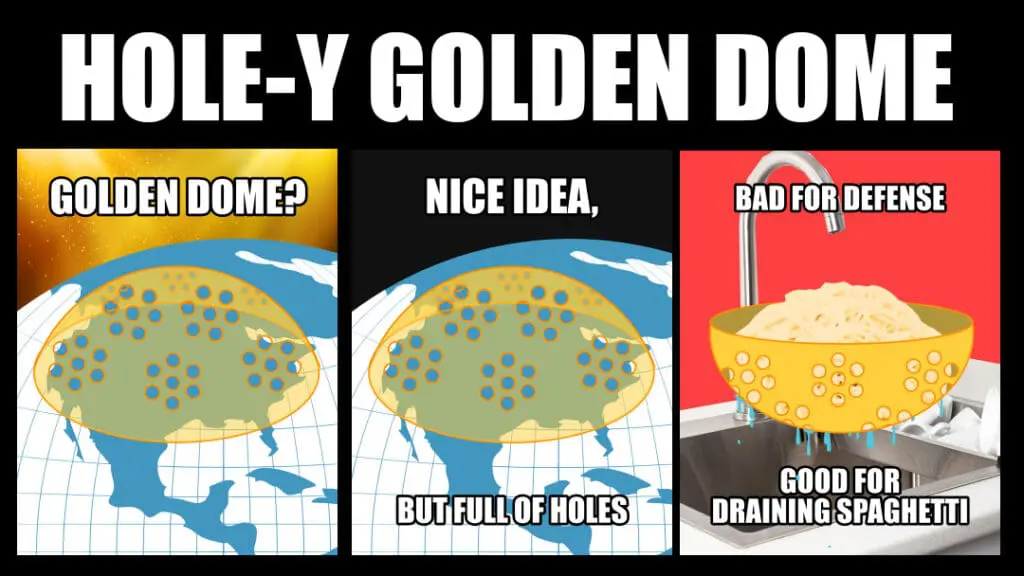
Any physics expert not on the dome payroll will tell you that the Golden Dome Invisible Shield will never work. But the Hole-In Dome Colander Company found a way to turn it into reality.
The Golden Dome is bad for Defense.
But the Hole-In Dome is great as a keepsake. A con-vo-sation piece. A little memento of the corruptitude of the Pentagon. And it’ll help you drain your stuff in style.
Take Action
They’re wasting our money on overkill instead of investing in the stuff our families really need. We can change that.
Make a Donation
Donate to support events, ads, and PR. Let’s drop the veil to expose this insanity and build public support to turn things around. We are the people we’ve been waiting for.
Sign Up
to tell Congress to stop overkill Pentagon spending and invest in housing, healthcare, and education.